Exhibitions Online
Items from the Art collection are featured in the following online exhibitions.
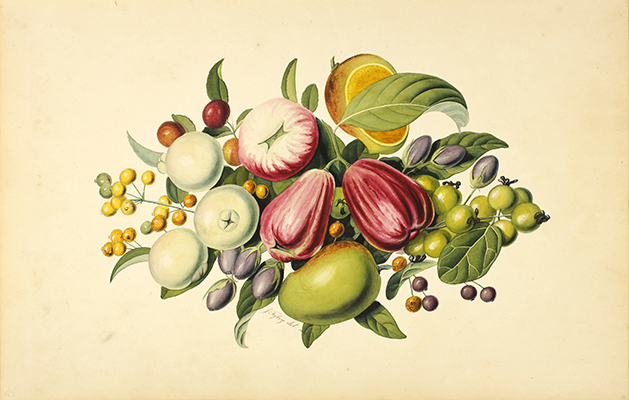
Botanical Watercolors of John Tyley: Free Man of Color in a Colonial World
From his birthplace on Antigua to his employment on Saint Vincent to his time in London, John Tyley (ca.1773–after 1823) navigated the colonial world with its complexities and contradictions. In honor of Black History month the Hunt Institute exhibits its John Tyley watercolors in conjunction with an issue of Huntia devoted to new scholarship about the artist. After nearly 70 years we are pleased to share our entire collection of Tyley-attributed watercolors with the public for the first time, and we invite everyone to learn more about this man, his complex life and his art.
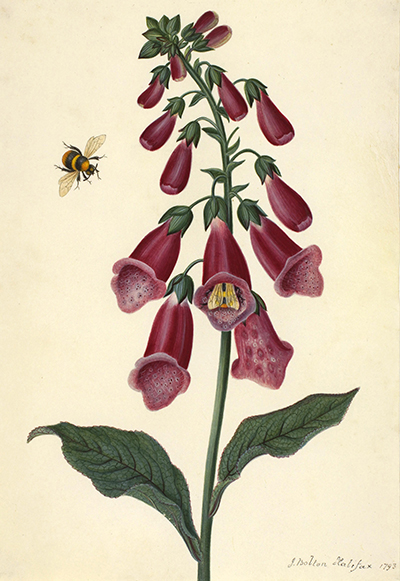
To Make a Prairie: Pollination and Human Understanding
Building on the words of Emily Dickinson, "To make a prairie it takes a clover and one bee," our spring exhibition explored how humanity came to understand one of nature's most essential relationships: the intricate partnership between plants and their pollinators. Although the Hunt Institute specializes in the history of botany, our Art Department presented this exhibition not as a lesson in botany but rather as an exploration of how we came to know what we know. Through historical specimens, illustrations and writings, To Make a Prairie traced the evolution of knowledge about plant reproduction from anecdotal observation to scientific fact and examined how those discoveries were shared, debated and accepted by the global community. Visitors encountered stories of curiosity, collaboration and revelation, demonstrating how centuries of observation transformed into scientific consensus. The exhibition reminded us that the relationship between humans and the natural world is one of reciprocity and wonder, each discovery deepening our understanding of the living systems that sustain us.

17th International Exhibition of Botanical Art & Illustration
This exhibition included 43 artworks by 43 artists, representing 19 countries (Australia, Chile, China, Colombia, England, Hungary, India, Italy, Japan, Netherlands, Portugal, Romania, Russia, Scotland, Singapore, South Korea, Turkey, Ukraine and the United States). The 17th International artists included Natalia Alatortseva (Russia), Anita Barley (Australia), Claudia Campazzo (Chile), Benjamín Cárdenas (Colombia), Hyunjin Cho (South Korea), Paresh Churi (India), Toni Dade (England), Andreia d'Almeida (Portugal), Hans de Vries (Netherlands), Christiane Fashek (United States), Maria Grazia Gianella (Italy), Alexandra Gorchakova (Russia and Hungary), Yoko Harada (Japan), Marianne Hazlewood (Scotland), Chie Imamura (Japan), Jackie Isard (England), Yan Ji (China), Hyojung Kim (South Korea), Marina Kiselyova (Ukraine and England), Joyce Byung Sook Ko (South Korea and United States), Svetlana Lanse (Russia), M. Joy Lemon (United States), Maria Lombardi (Australia and Italy), Antoinette Luchessa (United States), Tammy McEntee (United States), Victoria Mezenova (Russia), Kimiko Miyahara (Japan), Mibu Nakamura (Japan), Irina Neacsu (Romania), Keiko Nibu Tarver (Japan), Gillian Rice (United States), Michele Rodda (Italy and Singapore), Betsy Rogers-Knox (United States), Yasue Sakai (Japan), Margaret Saylor (United States), Irina Stolyarova (Russia), Anna Suprunenko (England and Russia), Pamela Taylor (England), Susan Tomlinson (United States), Donnett Vanek (United States), Sunanda Widel (Singapore), Michie Yamada (Japan) and Hürmüz Yeniceli (Turkey). The artworks were selected by the Hunt Institute jury team of Curator of Art Carrie Roy, Curatorial Assistant Lydia Rosenberg, Honorary Curator of Art Francesca Anderson, Director T. D. Jacobsen and Director Emeritus Robert W. Kiger.

Looking Back: An International Retrospective, Part 2
We concluded our two-part retrospective exhibition to celebrate the upcoming 60th anniversary of our International Exhibition of Botanical Art & Illustration series. Featuring some of the 1,212 artists who have been included in the series since 1964, the spring 2024 exhibition, Looking Back: An International Retrospective, Part 2, included works by 43 artists from the 9th–16th Internationals. The celebration culminated with the opening of our 17th International Exhibition of Botanical Art & Illustration in fall 2024.

Looking Back: An International Retrospective, Part 1
To celebrate the upcoming 60th anniversary of our International Exhibition of Botanical Art & Illustration series, we had a two-part retrospective exhibition in fall 2023 and spring 2024 featuring some of the 1,212 artists who have been included in the series since 1964. The fall 2023 exhibition, Looking Back: An International Retrospective, Part 1, included works by 46 artists from the first eight Internationals. The celebration culminated with the opening of our 17th International Exhibition of Botanical Art & Illustration in fall 2024.

Order from Chaos: Linnaeus Disposes
Carolus Linnaeus (also Carl von Linné, 1707–1778) was a Swedish botanist, physician and zoologist whose work laid the foundations of modern biological systematics and nomenclature. Long before Linnaeus, classical science was important in the shaping of subsequent science in the West. Transmitted through the cultures of the Mediterranean area, classical science was recovered during the Renaissance and ensuing Scientific Revolution and undergirded the search for a new botanical system. Drawing on the work of his predecessors and contemporaries, Linnaeus developed a coherent system for describing, classifying and naming organisms. Linnaeus' students traveled the globe to explore and collect information and specimens. Aspects of the Linnaean system have enabled amateurs and professionals worldwide to identify, name and describe plants for more than two centuries.

Virtues and Pleasures of Herbs through History
Through history the virtues and pleasures of herbs have enhanced our daily lives and connected us to the natural world through all of our senses. Through the centuries herbs have been used not only for medicinal purposes but also to flavor and preserve food, to scent and protect household environments and to dye or stain the skin and textiles. From the countless cultivated or wild herbs with overlapping applications we have chosen a selection within the four categories of physic, flavor, fragrance and dye. Each topic provides highlights of the usage of five herbs at specific points in history. The 20 herbs are illustrated by original watercolors and prints, rare books or manuscript pages from the Hunt Institute's Art, Library and Archives collections.